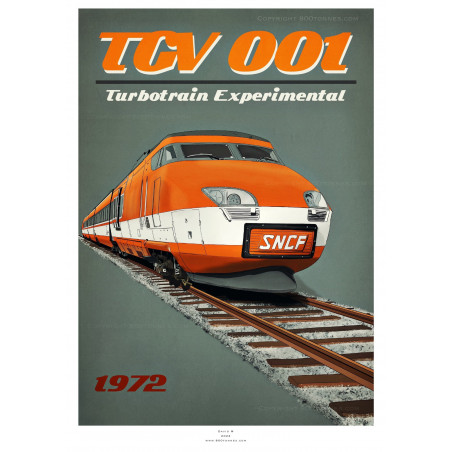

A poster of TGV 001, the experimental turbotrain from 1972.

Secure payment

Choice of delivery methods
 14-day return policy
(except magazines)
The TGV 001 was an experimental turbotrain, commissioned in 1972.
It was designed in collaboration between SNCF and Alsthom to explore the 250-300 km/h speed range, with a view to creating a network of high-speed lines. Built by Alsthom, Brissonneau et Lotz, Turbomeca and M.T.E. TGV 001 is listed as a "Historic Monument".
This trainset, which still holds the world record for autonomous rail speed (318 km/h on December 8, 1972), was never used in commercial service. Its existence was mainly the consequence of a research program on high-speed rail, covering all technical aspects, including traction, vehicle dynamics, braking, aerodynamics and signalling.
However, with the oil crisis of 1974, the use of RTGs, which were far too fuel-hungry, became less and less profitable in the face of electric traction, and electrically-powered trainsets were favored (resulting in the TGV as we know it today).
Two examples are still visible: TDu 001 is on display at the edge of the A4 freeway near Schiltigheim-Bischheim. TDu 002 can be seen on the A36 freeway near Belfort-Glacis du Château.

Data sheet
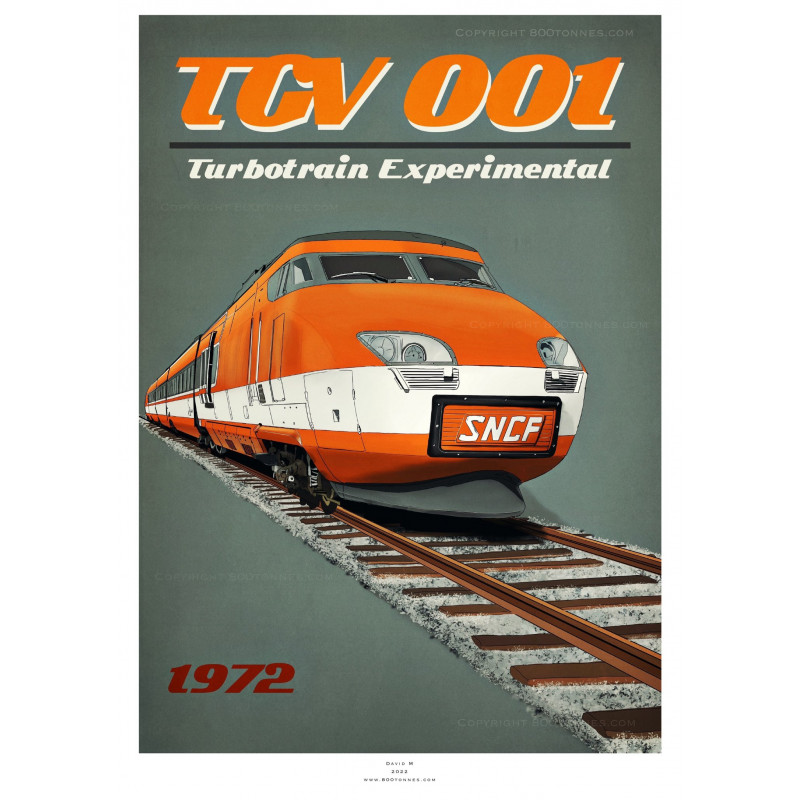
A poster of TGV 001, the experimental turbotrain from 1972.